
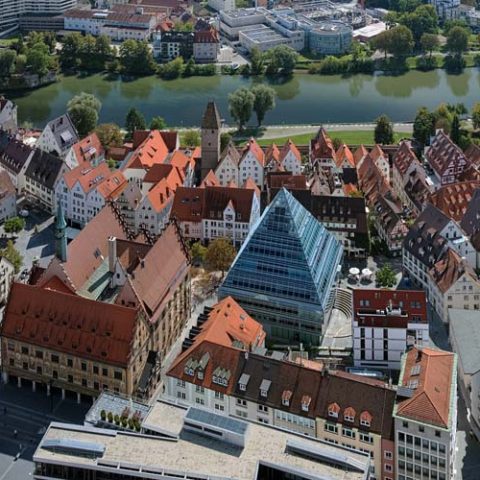
Pau pour la France, Ely pour l’Angleterre, Ulm pour l’Allemagne : derrière ces villes aux noms tout petits se cachent un charme bien plus grand… À l’occasion de votre prochain séjour linguistique ado en Allemagne, c’est sur la troisième de cette (courte, décidément) liste que LEC a choisi de s’arrêter. Ensemble, traversons le Rhin, le temps de quelques minutes…
Une ville dans le Land de Bade-Wurtemberg
Commençons par situer Ulm. Si vous souhaitez découvrir la ville au cours d’un séjour linguistique ado en Allemagne, il vous faudra vous rendre dans le Land de Bade-Wurtemberg, région collée à la France et abritant, entre autres choses, la ville de Stuttgart, la Forêt-Noire, ou encore le lac de Constance.
Vue sur le Danube
Ulm est bâtie sur le Danube, à l’instar d’une Vienne, d’une Bratislava, d’une Budapest ou d’une Belgrade. En 2011, elle comptait environ 117 000 habitants, soit environ autant qu’une ville comme Boulogne-Billancourt, de ce côté-ci du Rhin. Elle fait partie des cinq villes les plus peuplées de sa région, derrière Stuttgart, Mannheim, Karlsruhe et Heidelberg.
Que faire à Ulm ?
De passage à Ulm en séjour linguistique ado en Allemagne, on prendra le temps d’en apprendre plus sur l’histoire de celle qui, annexée à la Bavière à l’aube du 19e siècle, fut enlevée par Napoléon seulement un an plus tard. On y trouvera une cathédrale gothique entreprise à la fin du 14e siècle, dotée d’une tour colossale à la quantité pléthorique d’œuvres d’art, et dont les stalles furent sculptées par Jörg Syrlin l’Ancien au 15e siècle. Ulm est également une ville de musées, entre le Weishaupt, le Musée d’Ulm ou encore le musée central des souabes du Danube.
Un personnage célèbre né à Ulm… et pas des moindres
Mais la fierté d’Ulm reste, pour beaucoup, que la ville fut le théâtre de la naissance du plus célèbre des physiciens : Albert Einstein, venu au monde le 14 mars 1879 !