

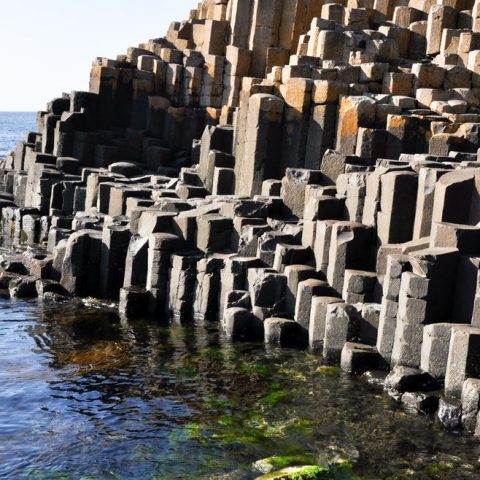
L’UNESCO a jugé bon de lister ce site de l’île d’Emeraude au patrimoine mondial – et pour cause ! Ce paysage à peine croyable, c’est la Chaussée des Géants, dont LEC vous dresse aujourd’hui le portrait à l’occasion de votre séjour linguistique en Irlande…
Giant’s Causeway ou Clochán na bhFómharach
Lors de votre séjour linguistique en Irlande, si vous évoquez le sujet avec des anglophones, il s’agira pour vous d’employer le nom de Giant’s Causeway. Si vous vous y essayez en irlandais, il faudra parler de Clochán na bhFómharach, signifiant littéralement Le petit tas de pierre des Fomoires – ces derniers étant des êtres maléfiques de la mythologie celtique irlandaise.
Séjour linguistique en Irlande : où trouver la Chaussée des Géants ?
Curiosité naturelle d’Irlande du Nord située dans le comté d’Antrim, en face de l’île Rathlin, la Chaussée des Géants est une formation volcanique formée de quelques 40 000 colonnes de basalte, qui viennent s’étendre à une grande distance dans la mer. C’est leur surface, érodée par la mer, qui a su leur attirer la curiosité des touristes et autochtones : celle-ci forme un pavage grossier tout simplement unique en son genre.
La légende de la Chaussée des Géants
Mais pourquoi parle-t-on de Chaussée des Géants ? Voici l’explication, que vous pourrez à coup sûr évoquer lors de votre prochain séjour linguistique en Irlande. Selon la légende, deux géants ennemis vivaient de chaque côté de la mer : l’un en Irlande, l’autre en Écosse. Le géant irlandais jeta des pierres dans l’eau pour construire un chemin praticable afin d’aller affronter son ennemi, tandis que ce dernier pris soin de démonter la chaussée pour que l’Irlandais ne puisse l’atteindre !